You can partially blame George Dantzig for military rations. One of the earliest applications of his 1947 simplex algorithm was the famous diet problem: how to feed soldiers at minimum cost while meeting nutritional requirements. Although Dantzig did not invent the modern Meal, Ready-to-Eat (MRE), his work on linear programming transformed military logistics and made large-scale ration optimization practical.
My efforts with RainbowStats are two-fold. First, to build a practical statistical toolkit for everyday analysis. Second, to recreate and extend many of the models and algorithms that I first encountered—or built myself—over the past fifty years.
My first implementation of the simplex method was likely around 1975, written on punch cards and submitted to an IBM 360 mainframe. Like many students of that era, I learned optimization the hard way: one deck of cards, one batch run, and one syntax error at a time.
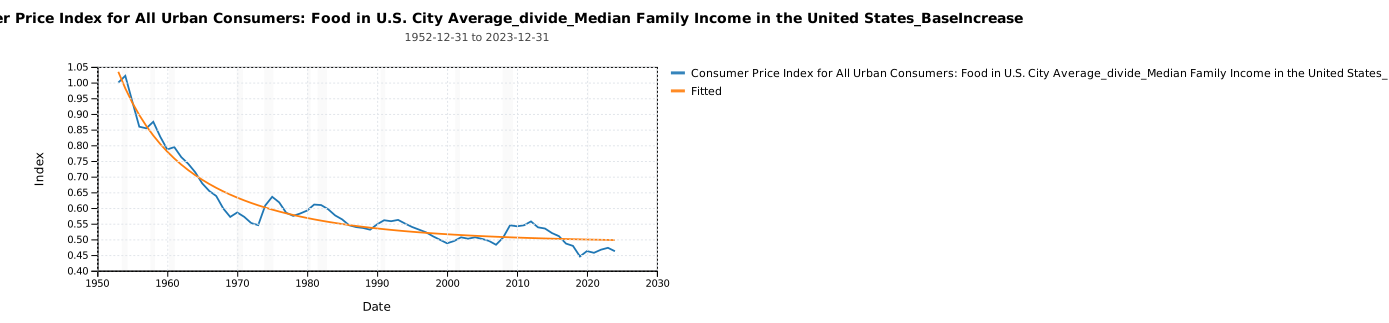
In a previous post, I showed that the cost of food as a percentage of median family income has steadily declined since 1980. In this article, I revisit that observation using the simplex method itself. By formulating a nutritional optimization problem similar to Dantzig's original diet problem, we can estimate the minimum cost of meeting basic dietary requirements over time and demonstrate just how dramatically the economic burden of food has fallen for the typical American household.
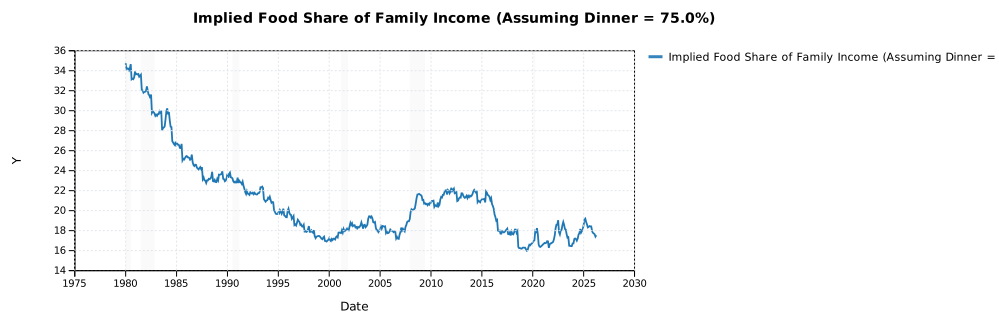
The chart above is straightforward. My question is whether families use substitution techniques to control the household food budget. To test that idea, I created an interactive linear program that builds a food budget for a family of four earning the median U.S. income. The program selects foods that meet the family’s nutritional requirements while minimizing total cost. I then run the same optimization for each monthly date from January 1980 through May 2026.
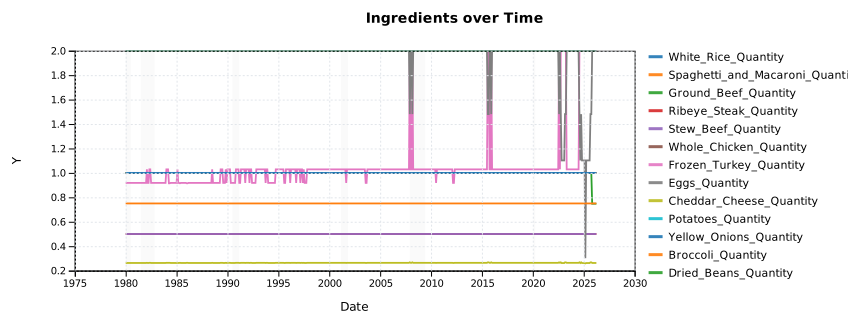
Every parent knows that preparing meals is not simply a matter of minimizing cost. If it were, the solution would be beans and broccoli every night. Until this exercise, I had no idea broccoli was considered such a nutritional powerhouse. To make the problem more realistic, I added minimum food requirements for meat, chicken, and other protein sources.
The results below show that over time there is little if any substitution between food groups based on cost. The results also show that as in the above chart the cost feeding a family of four as percent of income has steadily declined.
What the study does not show is the substition effect of dining inside the home versus dining at outside in fast-food resturants. Families must budget for time in preparing tthe food as both parents often work to make ends meet.
That study will be forthcoming. Meanwhile, eat your brocolli.
RainbowStats combines econometric modeling with interactive visualization to help identify these changing relationships, allowing users to move beyond static models and explore how the economy behaves across different regimes.