Artificial intelligence has become one of the dominant themes in the equity market. But the relationship between AI leadership and the broader market is not constant. It changes over time.
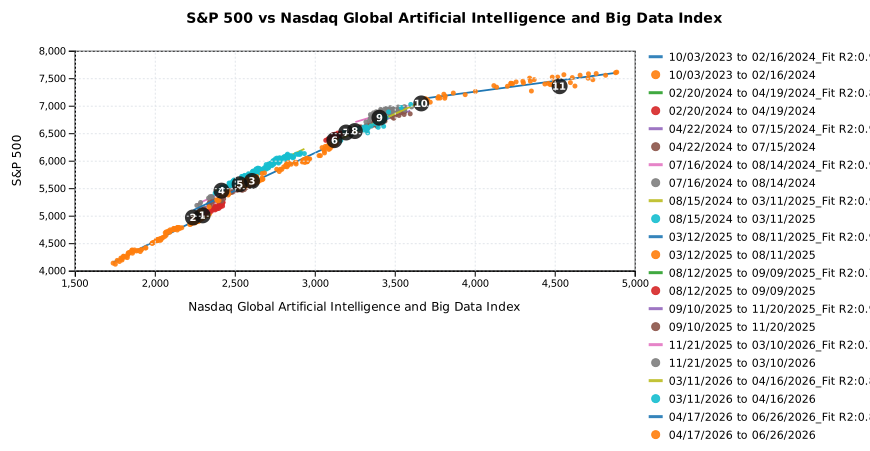
In this example, I use the RainbowStats BINARY_SPLIT operator to examine the
relationship between the S&P 500 and the Nasdaq Global Artificial Intelligence and
Big Data Index.
slideShow(binary_Split(last(sp500,n),last(NASDAQQNYGBIG,n)))Rather than forcing one regression line through the entire sample, the binary split approach searches for changing regimes. It divides the data into time periods where the relationship appears more stable, then fits each segment separately.
The result is a useful picture of how the market's attitude toward AI leadership changes through time.
The relationship between the AI index and the S&P 500 is often extremely tight. Several segments have R-squared values above 0.95. That means the two series moved together very closely during those periods.
But the slope and strength of the relationship are not fixed. Some periods show a stronger link between AI leadership and the broad market, while other periods show a temporary weakening.
A standard regression assumes one stable relationship across the entire sample. Financial markets rarely behave that cleanly.
Themes become dominant, fade, and then return. AI appears to have acted this way: sometimes functioning as a central driver of broad market performance, and at other times becoming less decisive.
The question may not be whether AI matters to the market. The better question may be: when does the market decide that AI matters most?
This is where BINARY_SPLIT is useful. It is not just a charting tool. It is a
simple way to detect changing relationships in market data.
The operator helps identify periods where a relationship is stable and periods where it shifts. In this case, it shows that AI leadership and the S&P 500 have moved through several identifiable market regimes.
That is often more informative than a single full-sample regression.
Run the complete analysis in RainbowStats
The chart suggests that AI has not been merely another sector theme. At times, it has acted more like a market state variable — a signal of leadership, risk appetite, and growth expectations.
When the relationship is tight, AI leadership appears deeply embedded in the broad market move. When the relationship weakens, the market may be rotating, broadening, or questioning the valuation premium attached to AI.
The interesting part is not just the high R-squared values. It is the way those values change from one regime to the next.