Run the complete analysis in RainbowStats
Home | Blog | Command Reference | Launch RainbowStats
Recent headlines have suggested that the decline in the U.S. personal saving rate is largely the result of higher gasoline prices following renewed geopolitical tensions in the Middle East. While rising fuel costs certainly pressure household budgets, the relationship is more complex than a single headline suggests.
Households operate under a budget constraint. When gasoline prices rise unexpectedly, most families do not immediately drive less or change their daily routines. Instead, they often adjust other parts of their budget, including discretionary spending and personal saving. The important question is whether this relationship has been consistent over time.
Using RainbowStats, we examined this question with several complementary techniques, including split regression, transfer function analysis, and rolling beta estimation.
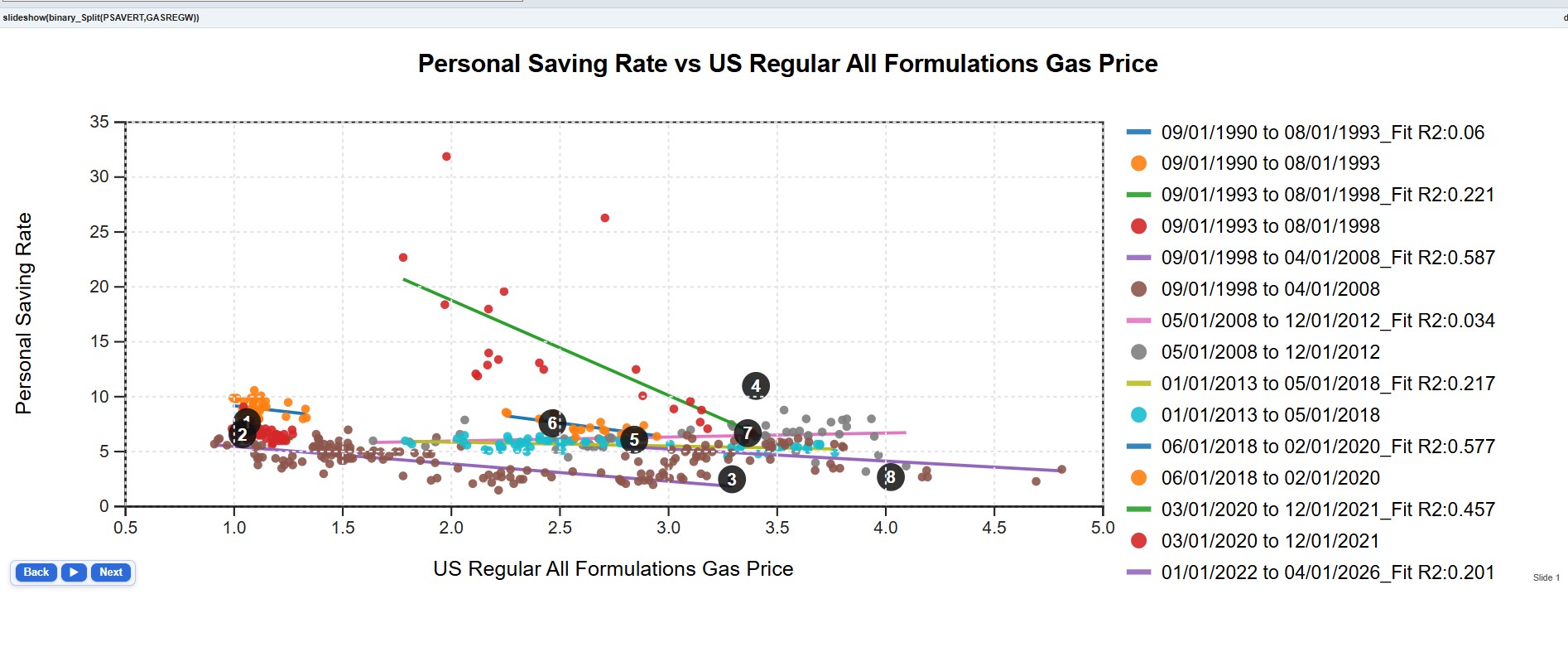
Rather than estimating a single regression over the entire sample, the split regression identifies periods with distinct economic behavior. Several regimes exhibit a clear negative relationship between gasoline prices and the personal saving rate, while others show little relationship at all.
This result is intuitive. Gasoline is largely a non-discretionary purchase. Most households still need to commute to work, take children to school, and shop for groceries regardless of fuel prices. When fuel costs rise, one of the easiest adjustments is often to save less.
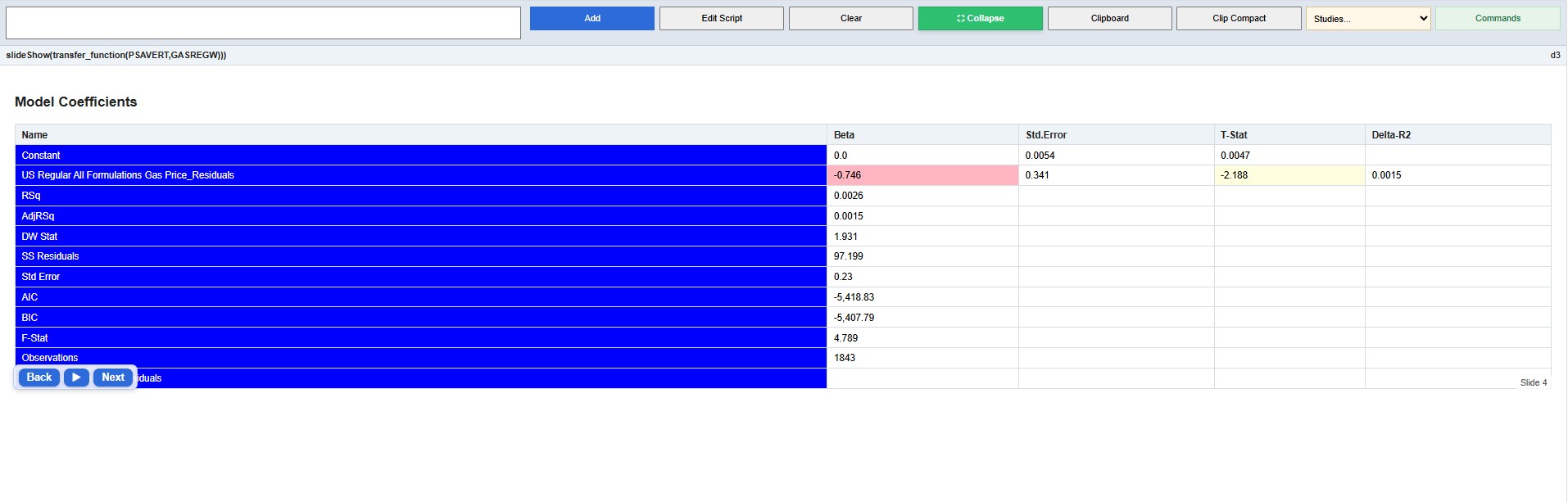
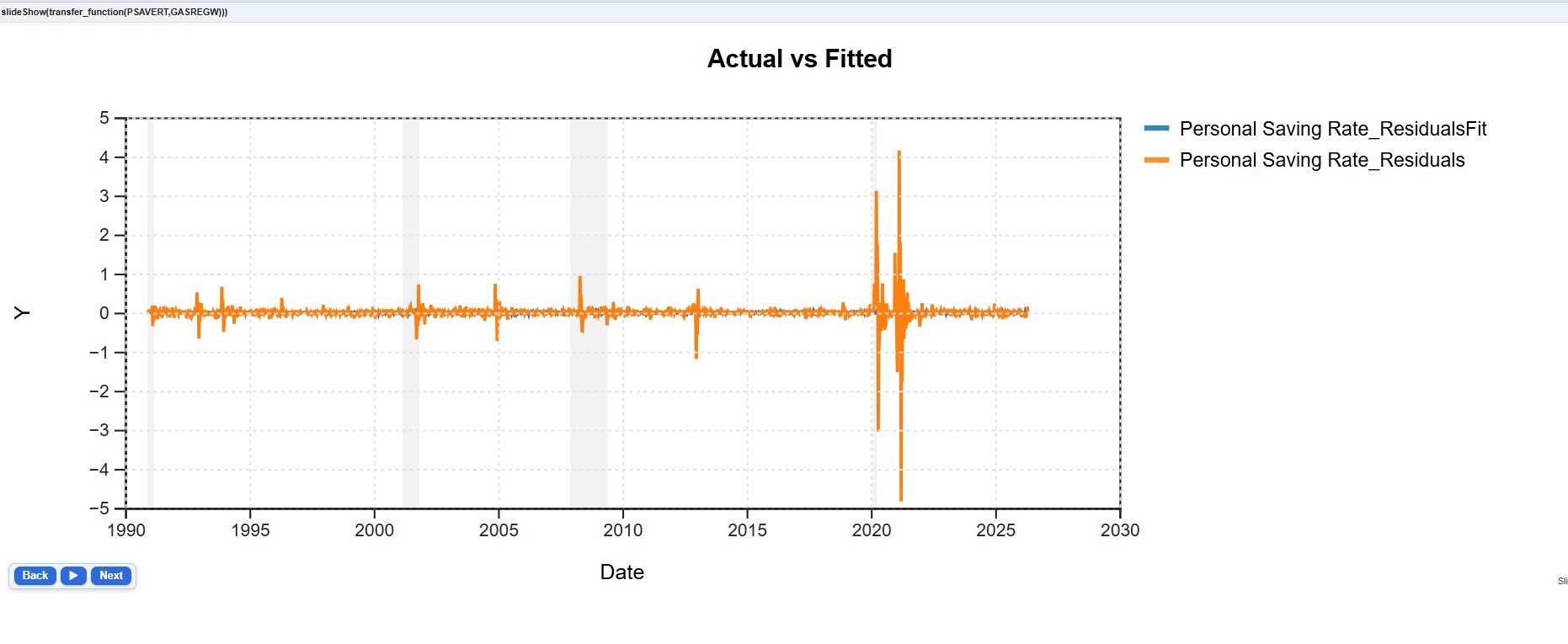
A transfer function model filters both series using ARIMA models before estimating the relationship between gasoline prices and the saving rate. After accounting for autocorrelation, the estimated gasoline coefficient remains negative and statistically significant.
The overall explanatory power of the model is modest, however. This is not surprising because the relationship itself is not constant. Major events such as the financial crisis, the COVID-19 pandemic, and the inflation surge following 2020 fundamentally altered household behavior.
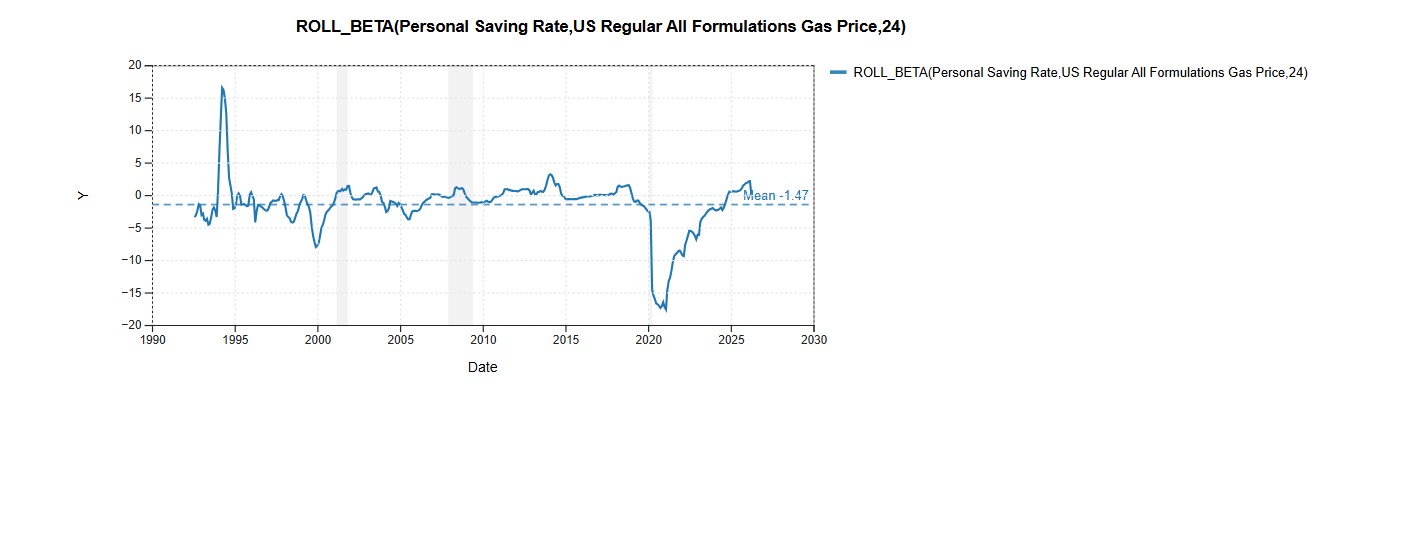
The rolling beta provides perhaps the most interesting insight. For much of the sample, gasoline prices have only a modest influence on personal saving. During the inflation and energy shock of 2020–2022, however, the relationship became substantially stronger as households absorbed sharply higher fuel costs by reducing saving.
As inflation moderated and labor markets remained resilient, the relationship weakened again. Rather than being fixed, the sensitivity of the saving rate to gasoline prices changes with the broader economic environment.
This analysis illustrates why a single regression is often insufficient for understanding macroeconomic relationships. Economic behavior evolves as households adapt to changing financial conditions.
RainbowStats combines econometric modeling with interactive visualization to help identify these changing relationships, allowing users to move beyond static models and explore how the economy behaves across different regimes.